
Last updated: September 17, 2026
For San Diego property owners weighing tpo roofing options, TPO membrane systems stand out as a solution that delivers both immediate energy performance and decades of reliable protection. Unlike traditional roofing materials that focus primarily on weatherproofing, TPO roofing combines advanced reflective technology with the durability needed to perform in Southern California’s intense sun. Property owners who prioritize long-term value over lowest upfront cost increasingly choose this single-ply membrane for its balance of efficiency, resilience, and warranty-backed peace of mind. Gastelum Roofing specializes in professional roofing services for residential and commercial clients throughout the San Diego region, helping property owners in Santee, Escondido, La Mesa, and Carlsbad make informed decisions about their roofing investments.
What Is TPO Roofing and How Does It Work?
TPO roofing is a single-ply thermoplastic membrane that provides energy-efficient, durable protection for flat and low-slope roofs. It combines reflective white surfacing with heat-welded seams to create a watertight, long-lasting envelope that resists UV damage and temperature extremes. This technology offers an alternative to traditional built-up systems.
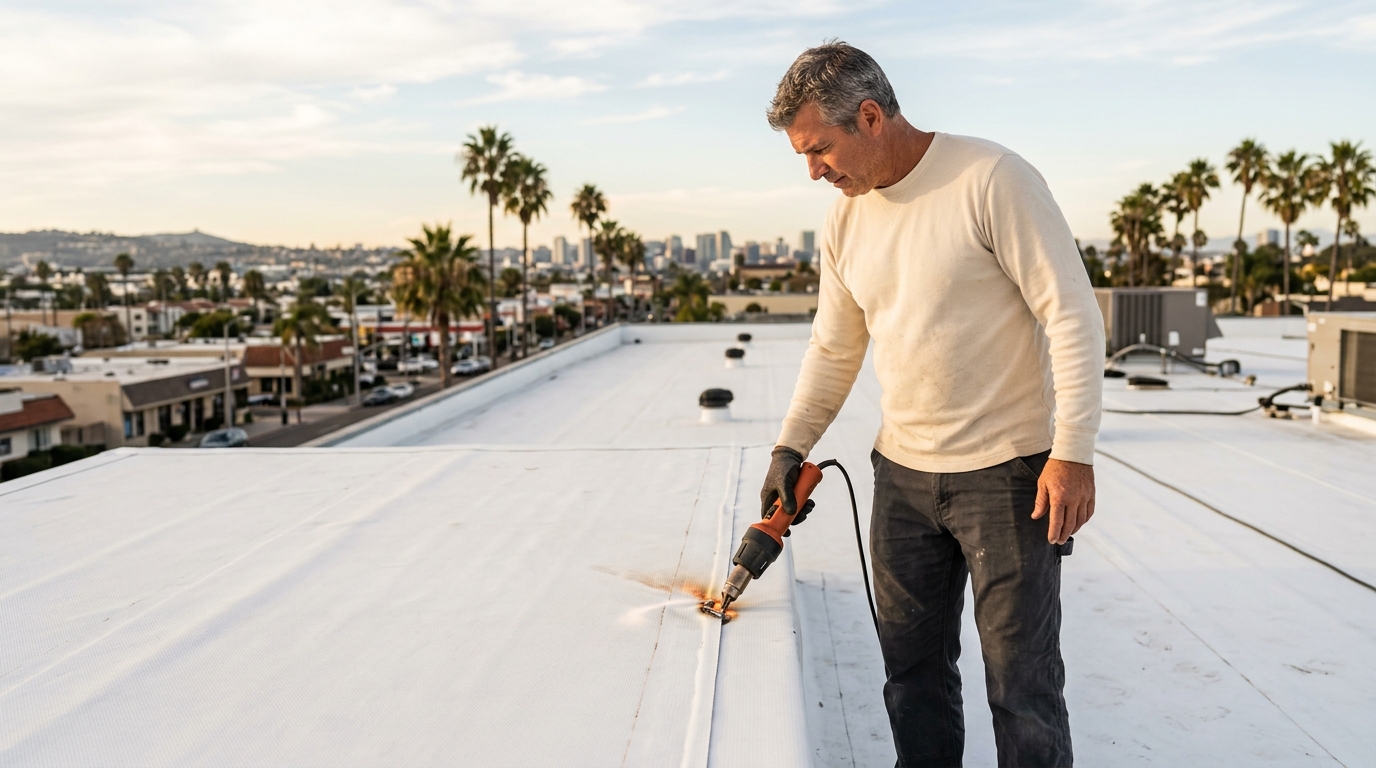
TPO roofing is a single-ply membrane system manufactured from thermopolastic polyolefin, a blend of polypropylene and ethylene-propylene rubber reinforced with a polyester fabric scrim. This composition creates a flexible yet sturdy sheet that installers roll out across flat and low-slope roof decks. The membrane typically comes in wide rolls, allowing fewer seams compared to traditional built-up roofing systems. During installation, contractors secure the membrane either mechanically with screws and plates or fully adhered with adhesive, then heat-weld the overlapping edges together using hot air equipment. This welding process fuses the seams into a unified, watertight bond that resists separation better than adhesive-joined or taped connections. The result is a continuous protective envelope that protects the building structure underneath from moisture, UV radiation, and temperature extremes. Industry professionals value this system for its relatively straightforward installation requirements and its performance characteristics on commercial and residential flat roof applications.
What are the key components of a TPO membrane system?
A complete TPO membrane system includes several integrated layers working together to provide protection. The base layer consists of a polymer pitch that forms the foundation of the sheet, while a polyester reinforcing scrim in the middle adds dimensional stability and resistance to tearing or puncturing. The top surface features a cap stock layer formulated with UV-resistant additives and thermal stabilizers that protect against sun degradation. Most TPO membranes come in white, though tan and gray options exist, with the white formulations offering the highest solar reflectivity. Edge trim, termination bars, and appropriate flashing materials complete the system, ensuring watertight transitions at roof perimeters, penetrations, and transitions. A quality installation also incorporates appropriate insulation boards beneath the membrane, which improve energy performance and provide a smooth, stable substrate for the membrane.
How does TPO differ from other flat roofing materials?
TPO differs from other flat roofing options in several meaningful ways. Compared to traditional built-up roofing, which layers asphalt and gravel, TPO installs as a lightweight single sheet without the mess of hot asphalt kettles or multiple plies of material. Against EPDM rubber roofing, another single-ply option, TPO offers better resistance to punctures and tears while providing superior heat reflection from its white surface. PVC roofing shares TPO’s heat-weldable seam technology but typically costs more and contains plasticizers that can leach over time. TPO occupies a middle ground, delivering professional-grade performance at a competitive price point while avoiding the environmental concerns associated with older membrane technologies. For San Diego buildings, TPO’s combination of heat reflection, durability, and heat-welded seams creates a balanced solution that performs exceptionally well in the region’s climate conditions. For a closer comparison, explore TPO vs PVC roofing to see which membrane best fits your flat roof.
Why Does San Diego’s Climate Make TPO an Ideal Roofing Choice?
TPO roofing handles San Diego’s intense sunshine and mild climate exceptionally well. Its UV-resistant formulation prevents degradation, while its reflective surface reduces cooling costs. The membrane’s durability against sun exposure translates to longer service life with minimal maintenance in the region’s consistently sunny conditions.
How does TPO handle San Diego’s intense sunshine?
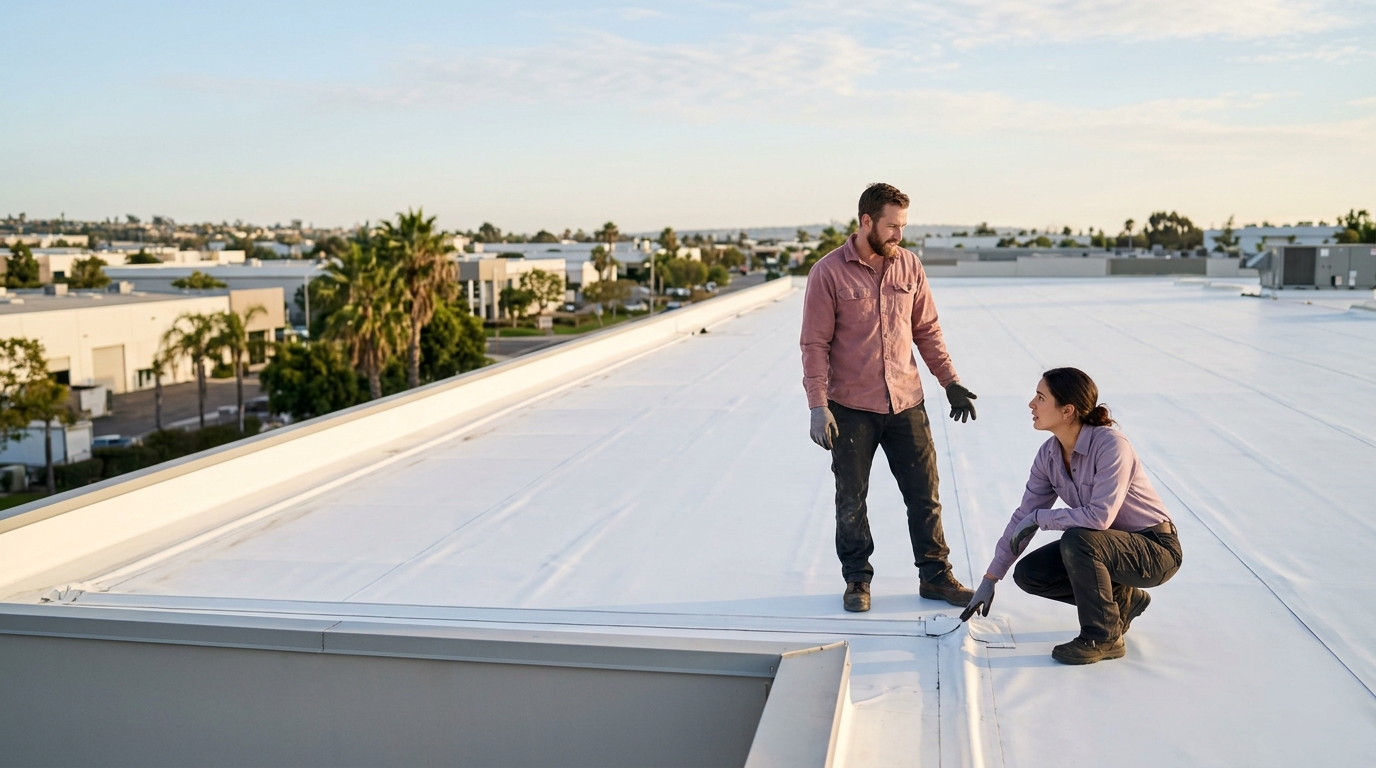
TPO membranes handle intense sunshine through their reflective surface and UV-stable formulation. The white pigmentation of standard TPO reflects a significant portion of solar radiation rather than absorbing it into the building structure. This means roof surface temperatures remain considerably lower than they would under dark roofing materials, reducing thermal stress on the membrane itself and decreasing heat transfer into the building interior. The polyolefin chemistry of TPO includes stabilizers that resist the oxidative degradation that typically breaks down polymers under UV exposure. This combination of reflectivity and stability allows TPO to maintain its performance characteristics year after year despite the relentless San Diego sun, providing building owners with reliable protection without the degradation that plagues less advanced materials.
What energy savings can San Diego property owners expect from TPO roofing?
TPO roofing delivers measurable energy benefits for San Diego property owners through its reflective surface and thermal performance characteristics. Buildings with TPO membranes experience reduced cooling loads during warm months, as the reflective surface prevents solar heat from entering the structure. This translates into lower air conditioning demands and reduced energy consumption for temperature control. Property owners in El Cajon, Escondido, and throughout the region have adopted white membrane roofing specifically for these efficiency advantages. The energy savings compound over the life of the roof, making TPO an investment that pays ongoing dividends through reduced utility expenses. For commercial properties with large roof areas, these savings can be substantial, making TPO an increasingly popular choice among building operators focused on operational efficiency.
How Does TPO Roofing Deliver Long-Term Value Over Initial Cost?
TPO roofing provides long-term value through reduced maintenance, energy savings, and extended service life. While initial costs may exceed some alternatives, the durability of heat-welded seams and UV-resistant formulation minimize repair needs and replacement expenses over two to three decades of reliable performance.
Evaluating roofing investments requires looking beyond initial material and installation expenses to understand true cost of ownership over time. TPO membrane roofing excels when examined through this lens, offering property owners a solution that minimizes expenses throughout its service life rather than just reducing upfront costs. The material’s durability means fewer repairs, while its heat-welded seams resist the failures that plague other systems. Property owners who choose TPO often find that the reduction in maintenance needs and extended service life create meaningful savings that offset any difference in initial investment. This total-cost-of-ownership perspective aligns with how experienced roofing professionals evaluate system value, and it represents the approach Gastelum Roofing takes when advising clients about roofing investments.
What makes TPO a cost-effective investment over 20+ years?
TPO becomes increasingly cost-effective over two decades and beyond through its durability and minimal maintenance requirements. The membrane resists punctures, tears, and chemical exposure that would damage lesser materials, reducing the likelihood of emergency repairs or premature replacement. Its heat-welded seams maintain integrity through temperature cycles that cause adhesive-bonded systems to fail, eliminating a common failure point that leads to leaks and interior damage. Building owners who install quality TPO systems can expect reliable performance with standard maintenance, avoiding the cycle of repeated repairs that characterizes less durable alternatives. When projected over twenty or thirty years, these avoided costs and consistent energy savings make TPO one of the most economically sound choices for flat and low-slope roofing applications. For TPO roofing repair, knowing what damage to check and when to call a professional helps protect that long-term value.
How do TPO’s durability features reduce maintenance concerns?
TPO’s durability features directly reduce maintenance concerns through resistance to common roofing problems. The reinforced membrane stands up to foot traffic during routine maintenance and HVAC service calls without tearing or puncturing, unlike thinner single-ply alternatives. It resists biological growth such as algae and mold that can degrade organic roofing materials over time. The material tolerates exposure to many industrial pollutants and acid rain better than asphalt-based systems, making it suitable for diverse environments. Heat-welded seams create bonds stronger than the membrane itself, eliminating the seam failures that represent the most common leak source in other single-ply systems. These characteristics mean facility managers and homeowners spend less time and money addressing roofing issues, allowing them to focus resources on other building priorities.
What Warranty Protection Comes With a Professional TPO Installation?
Professional TPO installation includes manufacturer material warranties plus contractor workmanship coverage. Certified applicators ensure warranty validity, protecting against material defects and installation errors. This dual coverage provides complete investment protection for the full roofing system, giving property owners confidence in their roofing investment for years to come.
Professional TPO installation through a qualified contractor provides warranty coverage that protects the full system investment rather than just material claims. Manufacturer warranties on TPO membranes typically cover material defects and premature degradation, but these warranties often require proper installation by certified applicators to remain valid. Beyond material coverage, comprehensive system warranties from established contractors include labor and workmanship, addressing issues arising from installation errors that material-only warranties typically exclude. This distinction matters significantly, as installation-related problems account for a substantial portion of roofing failures in the industry. Property owners who invest in professional installation gain the additional assurance that their warranty protection encompasses both the product and the installation itself, creating complete coverage for their roofing investment.
What coverage does a lifetime system warranty include?
Lifetime system warranties for TPO installations typically cover the full roofing system for the duration of building ownership, encompassing both materials and labor. Coverage addresses manufacturing defects in the membrane and component materials, failures due to improper installation, and workmanship issues that might cause leaks or premature degradation. The specific terms vary between manufacturers and contractors, with comprehensive warranties providing repair or replacement of affected areas along with associated damage to building interiors. A complete system warranty from a credentialed contractor gives property owners recourse if problems arise, transforming what could be a significant unexpected expense into a protected investment. When evaluating warranty offerings, property owners should understand exactly what is covered, for how long, and what conditions might void the warranty.
Why does contractor choice affect warranty protection?
Contractor choice directly affects warranty protection because many manufacturer warranties remain valid only when installation follows specific guidelines by certified applicators. Contractors must complete manufacturer training, demonstrate proper installation techniques, and often pay associated certification fees to offer full warranty coverage. Unqualified installers who cut corners or lack proper credentials may void material warranties entirely, leaving property owners with no protection despite paying for TPO materials. Established contractors with strong track records provide accountability that online sellers or uncertified installers cannot match, ensuring the warranty means what it says when problems occur. Choosing a contractor like Gastelum Roofing, with demonstrated experience and appropriate credentials, protects the warranty value and ensures the installation meets manufacturer specifications for coverage eligibility.
Is TPO Roofing Suitable for Both Homes and Commercial Buildings?
TPO roofing works for both residential and commercial applications with flat or low-slope roofs. Commercial buildings benefit from large-area efficiency gains, while homeowners enjoy the same reflectivity, durability, and heat-welded seam technology on smaller scale projects. This versatility makes TPO an excellent choice for diverse property types across the San Diego region.
TPO membrane roofing serves both residential and commercial applications effectively, adapting to the specific requirements of different property types. While commercial buildings represent the largest market for TPO systems due to their extensive flat roof areas and energy efficiency priorities, residential flat roofs and roof sections benefit equally from the material’s performance characteristics. The same qualities that make TPO attractive for warehouses and office buildings – reflectivity, durability, and heat-welded seams – translate directly to homeowner applications. Property owners across San Diego, whether managing apartment complexes in Carlsbad or single-family homes in La Mesa, can access professional TPO installation tailored to their specific building type and usage requirements.
What property types benefit most from TPO membrane roofing?
TPO membrane roofing benefits most from flat or low-slope roof configurations where traditional steep-slope materials perform poorly. Commercial properties including warehouses, retail centers, office buildings, and industrial facilities represent the largest segment of TPO applications, with large roof areas that maximize energy efficiency gains from the reflective surface. Multi-family residential buildings with flat roofs, such as apartment complexes and condominiums, similarly benefit from TPO’s durability and maintenance advantages. Single-family homes with flat roof sections, garage roofs, or porch additions also represent excellent candidates for TPO installation. Any property where roof slope prevents effective water runoff with conventional shingles or tiles can potentially benefit from TPO membrane roofing’s reliable performance characteristics.
How does installation differ for residential versus commercial applications?
Installation approaches differ between residential and commercial TPO applications based on building size, roof structure, and access considerations. Commercial installations typically utilize mechanical attachment systems, where screws and stress plates secure the membrane and insulation to the structural deck, providing strong wind resistance for large roof areas exposed to weather. Fully adhered systems using specialized adhesive work well for both applications and create a smooth appearance when visual presentation matters. Residential installations often favor adhesive attachment for its clean look and quiet performance under foot traffic. Both approaches require proper edge detailing, quality flashing at transitions and penetrations, and attention to substrate preparation. Regardless of application type, professional installation by experienced contractors ensures the heat-welded seams create reliable, continuous protection across the entire roof surface.
How Can San Diego Property Owners Get Started With TPO Roofing?
San Diego property owners can start by consulting professional TPO installers who understand local climate requirements. Gastelum Roofing provides expert assessment, installation, and warranty-backed service throughout the region, helping property owners select and implement appropriate TPO solutions for their specific needs.
TPO membrane roofing offers San Diego property owners a proven combination of energy efficiency, durability, and long-term value for flat and low-slope roofing applications. The material’s heat-reflective properties address the region’s intense sunshine directly, while its reinforced construction and heat-welded seams provide the resilience needed for decades of reliable service. Professional installation by qualified contractors ensures optimal performance and full warranty protection for this significant building investment. Gastelum Roofing serves property owners throughout the San Diego region, including Santee, Escondido, La Mesa, Carlsbad, Chula Vista, Poway, and El Cajon, with expert TPO installation and consultation services. The team brings decades of experience helping residential and commercial clients select and install roofing systems that meet their specific needs and budget considerations. For property owners considering TPO roofing for their next project, reaching out to Gastelum Roofing provides the opportunity to discuss options, receive detailed guidance, and take the first step toward a more efficient, durable roof. Contact Gastelum Roofing at 760-295-6593 to schedule a consultation and learn how TPO roofing can serve your property’s needs.
Frequently Asked Questions
Below are answers to common questions about TPO roofing systems, installation, and benefits for San Diego property owners considering this energy-efficient roofing solution. These FAQs address key concerns about performance, durability, cost, and warranty coverage to help property owners make informed decisions.
What is TPO roofing and how does it work?
TPO roofing is a single-ply membrane system made from thermopolastic polyolefin, combining polypropylene and ethylene-propylene rubber with a polyester reinforcing scrim. Installers roll out wide sheets across flat or low-slope roof decks, securing them mechanically with screws and plates or fully adhering with adhesive. The overlapping edges are heat-welded together using hot air equipment, creating watertight seams stronger than the membrane itself.
Why is TPO roofing ideal for San Diego’s climate?
TPO membrane roofing handles San Diego’s intense sunshine through its reflective white surface and UV-stable polyolefin chemistry with thermal stabilizers. The material resists UV degradation, preventing brittleness and cracking through years of sun exposure. This durability translates directly into longer service life and fewer maintenance concerns, making it specifically engineered for high-UV environments.
What energy savings can San Diego property owners expect from TPO roofing?
TPO roofing delivers measurable energy benefits through its reflective surface that reduces cooling loads during warm months. The white membrane reflects solar radiation rather than absorbing it, lowering roof surface temperatures and decreasing heat transfer into building interiors. Energy savings compound over the roof’s lifespan, with commercial properties experiencing the most substantial reductions due to their larger roof areas.
How long does TPO roofing typically last?
TPO membrane roofing provides reliable performance over 20 to 30 years with standard maintenance requirements. The reinforced membrane resists punctures, tears, and UV degradation, while heat-welded seams maintain integrity through temperature cycles that cause other systems to fail. This durability eliminates the cycle of repeated repairs that characterizes less advanced alternatives.
What warranty protection comes with professional TPO installation?
Professional TPO installation provides comprehensive warranty coverage encompassing both materials and labor. Manufacturer warranties cover material defects, but remain valid only when installed by certified applicators. Complete system warranties from established contractors include workmanship, addressing installation errors that material-only warranties exclude. Property owners gain full protection for their roofing investment when choosing credentialed installers.
Is TPO roofing suitable for residential homes?
TPO membrane roofing serves both residential and commercial applications effectively. While commercial buildings represent the largest market due to extensive flat roof areas, single-family homes with flat roof sections, garage roofs, or porch additions benefit equally from TPO’s reflectivity, durability, and heat-welded seams. The same qualities that attract commercial building owners translate to homeowner applications.
What makes TPO roofing durable and low maintenance?
TPO durability comes from its reinforced construction that withstands foot traffic without tearing, resists biological growth like algae and mold, and tolerates exposure to industrial pollutants. Heat-welded seams create bonds stronger than the membrane itself, eliminating the seam failures that represent the most common leak source in other single-ply systems. These features mean facility managers spend less time and money on roofing repairs.